The post Electrosmog: 10 Ways to Avoid Frying Your Brain appeared first on lifesfouhealth.com.
]]>The ever-expanding electrosmog is comprised of several EMF or electromagnetic radiation fields of different intensity: from ELFs (extremely low frequency fields) to “dirty electricity” — a frequency that gets on wiring in our walls from electronics that contain transformers; from compact fluorescent light bulbs and dimmer switches to RFs (radio frequencies), and a subset of RF called microwave radiation emitted by cell phones, wireless networks and portable phones.
“All these radiation fields disrupt the regulation of the nervous system in our bodies,” said Camilla Rees, during a recent interview on my radio show “Your Super Natural Life.” Camilla, founder of ElectromagneticHealth.org, is one of the foremost advocates for safer cell phone and wireless technologies, and exposes the link between electromagnetic pollution and our health. “We are electromagetic beings,” she said, “and are especially vulnerable to unnatural electromagetic fields.”
Many people are becoming “electrosensitive” due, in part, to being exposed to more and more wireless devices like computers, printers and routers, cell phones, or from living near cell phone towers or antennas. According to Camilla, electrosensitivity can show up as acute symptoms like excessive fatigue, sleep disturbances, headaches, irritability, visual problems, memory loss, difficulty in concentrating, dizziness and cardiovascular disruptions. Long-term symptoms include conditions like chronic fatigue, fibromyalgia and other chronic pain syndromes. “Even though you might not be experiencing symptoms now, doesn’t mean you won’t in the future due to increased exposure,” added Camilla.
Magda Havas, Ph.D., co-author with Camilla of “Public Health SOS: The Shadow Side of the Wireless Revolution,” says that it can take just a small amount over a long period of time to be affected. “Symptoms of electrohypersensitivity have been demonstrated at exposures that are a fraction (0.04%) of U.S. exposure guidelines, in part because the guidelines themselves only take into consideration a 30-minute exposure, not chronic exposures.” Magda is also author of the new BRAG Antenna Ranking of Schools Report,which ranks U.S. schools and shows parents and teachers how to gauge the risk of radiation exposure from neighborhood antennas.
Here are some factors that are known or suspected:
The post Electrosmog: 10 Ways to Avoid Frying Your Brain appeared first on lifesfouhealth.com.
]]>The post Tips for Taking Care of Your Skin This Summer appeared first on lifesfouhealth.com.
]]>The basic CTM (Cleansing, Moisturizing, And Toning) routine is beneficial for the skin all year round. Here’s what it entails:
Summer is when you need to up your sun protection game. A good natural broad-spectrum sunscreen helps prevent sunburns, pigmentation, and oxidative damage caused by harmful UVA and UVB rays. But applying a thick, cream-based sunscreen in the summer to protect your skin from the UV rays is not feasible. Instead, go for a non-greasy, water-based, and lightweight sunscreen that lets your skin breathe without looking shiny. Ensure it has SPF 30 or higher and reapply every couple of hours to keep your skin protected.
Your skin can easily get stressed and look dull in the scorching summer heat. Thus, it is vital to keep it nourished and protected. Use a cooling and rejuvenating face mask to beat the heat and protect your skin from tanning and burning. Look for ingredients like oatmeal, aloe vera, clay, cucumber, green tea, licorice, and chamomile.
Face masks help in exfoliating, hydrating, and moisturizing the skin, based on the ingredients in them. They form a layer over the skin and nourish it from within.
Read on for more DIY Beauty ideas
Wearing heavy makeup during the summer can make your skin feel heavy, shiny, and oily and requires multiple touch-ups. To top it all, sweat and humidity can take a toll on your skin’s texture and cause breakouts. Hence, use light makeup just to give a subtle tint of color to your skin. Water-based formulas work well in summers. Stay away from heavy and greasy products that don’t let your skin breathe.
Your eyes and lips are probably the most sensitive areas of the face and require intensive care. Protect your eyes from UV rays by wearing sunglasses whenever you step out. De-stress your eyes at night with night serum or cream to prevent puffiness, discoloration, and dark circles.
For lip protection, apply an SPF-based lip balm daily. Scrub away the dead skin and dullness two to three times a week using a mild lip scrub.
Learn about what's really in your lip balm
Not just your face, other body parts that are frequently exposed to the sun, such as your arms and feet, also need to be cared for.
Foot care is essential so that you can flaunt your tan-free and clean feet in sandals and flip-flops. Scrubbing your feet in the shower can be extremely helpful in preventing tan and dead skin. You can also opt for a full-fledged pedicure session every 15 days to ensure complete foot care.
You can’t prevent your arms and hands from getting tanned during the summer, especially if you are fond of wearing sleeveless clothes. Hence, daily care is essential. Exfoliating the dead skin from your arms once a week can help remove tan and leaves them smooth and clean.
Keeping hydrated is the key to maintaining healthy skin during the summer. It quenches the skin’s thirst and prevents dullness. Therefore, always carry a water bottle whenever you step out. Fresh fruit juices, coconut water, or electrolyte powders are also great ways to keep your body functioning and your skin hydrated.
The harsh sun rays and free radicals damage your skin and lead to the signs of aging. Investing in good anti-aging products can help reverse this damage to a certain extent. As you age, your skin starts to lose collagen and develops fine lines and wrinkles. The best line of defense for mature skin is to use retinoid or similar products like bakuchiol after consulting with a dermatologist. Try face oils and serums containing hyaluronic acid, niacinamide, and vitamin C to keep your skin nourished and hydrated. Use intensively moisturizing night creams with anti-aging ingredients like peptides, ceramides, coenzyme Q10, and AHAs (alpha-hydroxy acids).
The summer sun can damage your skin and make it look dull and lifeless. Not anymore! Following the tips given above can help you flaunt hydrated, clear, and problem-free skin all through the season. Enjoy your days in the sun!
The post Tips for Taking Care of Your Skin This Summer appeared first on lifesfouhealth.com.
]]>The post Wow! Red Wine Is Really Good for Me appeared first on lifesfouhealth.com.
]]>Except for my twice yearly wine fasts just to cleanse the insides so to speak – I actually don’t drink any wine for a full two months out of the year – I have a glass of wine every night. I drink my zin; my husband has his chard. So I’m very glad to know that my red wine is actually good for me.
Read: Wine-Baked Halibut Steaks With Mustard-Fennel Butter
I recently came across a blog called Wine Folly where the blogger – also named Madeline – says everything I wanted to hear about the benefits of red wine:
Red wine drinkers live longer than those who drink other liquors or beers
The polyphenols – powerful antioxidants – in red wine help us stay young. Red wine is more powerful than grape juice, blueberries (which I eat every single morning of my life), and the Acai berry. And the darker the red wine, the higher the amount of antioxidants.
The probiotics in the fermentation of red wine gives us more energy. But, wine drinkers beware. As much as I love red wine I drink in moderation. The limit guidelines are one glass for women and two glasses for men*. (That’s where my wine fasts come in. If I find myself inching up to two glasses a day, I know its time to stop drinking altogether and take a break.)
“Prevention” online also published 8 Reasons to Love Red Wine, again validating that drinking wine is definitely good for my body. Here’s the list:
1. Lowers cholesterol – the high-fiber Tempranillograpes seems to help lower cholesterol
2. Protects your heart – “…the antioxidants in red wine-can help keep blood vessels flexible and reduce the risk of unwanted clotting,” says John Folts, PhD, a professor of cardiovascular medicine and nutrition at the University of Wisconsin-Madison.
3. Controls blood sugar – red grape skins have a compound called resveratrol that may help diabetics regulate blood sugar. Resveratrol may also decrease cholesterol and blood pressure
4. Boosts your brain – another plus for resveratrol is that it helps keep our brains working properly
5. Fights off a cold – This must mean the antioxidants in red wine have helped me stay healthy. I hardly ever get a cold.
6. Stops cancer – scientists have found that resveratrol helps starve cancer-feeding cells
7. Helps you get slim – Piceatannol, the chemical compound our bodies convert from resveratrol, has been shown in lab tests to prevent the growth of fat cells
8. Jazzes up dinner – We don’t even need to drink a glass of red wine to reap its benefits. Use it in sauces or other complimentary ingredients – imagine roasting a leg of lamb with herbs and red wine.
The Mayo Clinic also chimes in about the heart healthy components of resveratrol in red wine – just so long as we drink it in moderation. It says:
“Antioxidants in red wine called polyphenols may help protect the lining of blood vessels in your heart…” and “Resveratrol might be a key ingredient in red wine that helps prevent damage to blood vessels, reduces ‘bad’ cholesterol and prevents blood clots.”
The clinic also says that redwine's potential heart-healthy benefits look promising for those who drink moderate amounts of alcohol, including red wine, because of a lower risk of heart disease. However, it emphasizes that more research is needed to determine whether red wine is better for our hearts than other forms of alcohol, such as beer or spirits.
Read: Heart Disease: Bad News, Good News
Another article, “Solid Proof That Red Wine Is Good for You,” which appeared in the Business Insider, also discusses the good properties of red wine. It especially likes how resveratrol – now looking like a miracle ingredient – can help fight diseases associated with aging such as type 2 diabetes, cancer, and Alzheimer’s. This news should be especially reassuring to all the boomers out there.
I also relate to the healthy aspects of red wine. Besides I really love a glass of wine in the evening. It’s relaxing, it goes well with dinner, and it provides a nice moment for my husband and I to share.
*A drink is defined as 12 ounces of beer, 5 ounces of wine, or 1.5 ounces of 80-proof distilled spirits.
Photo Credit: dinstereo
The post Wow! Red Wine Is Really Good for Me appeared first on lifesfouhealth.com.
]]>The post Abundance 101 appeared first on lifesfouhealth.com.
]]>Look around you right now. Do you see everything you are blessed with, or everything you are missing? It actually requires exercising your "I see nothing but blessings around me, or opportunities to be blessed" skills. If you frame your life that way, then you will wake up every morning excited to discover the blessings or the opportunities.
Let's say you've been talking about renovating your house, and now all you see is the ugly color of the wall, and the '60s shag carpeting-and every time you see it, you cringe. That's only because your perspective is that it needs to change. Perhaps it's a blessing that you have a wall to paint and an opportunity to be creative, and a blessing that you have warm carpet beneath you. I could certainly think of worse things!
Another example: maybe you do this about your body, too? Just think: the shape of your body matters so little compared to what that body has done for you.
So, how abundant are you? I have a challenge for you: generate a feeling of abundance that you can feel in your cells. Look around you, and collect as many examples of your prosperity as you possibly can. See if you can wipe the smile off your face!
Jennifer Hough
The post Abundance 101 appeared first on lifesfouhealth.com.
]]>The post Alexander Mostovoy appeared first on lifesfouhealth.com.
]]>He has lectured extensively across Canada, the United States, South America, and Europe, and has educated and trained physicians in breast cancer prevention and the use of medical thermography. He is the best selling author of the book Breast Cancer Is A Preventable Disease and a co-creator of the 2016 – Breast Cancer Prevention Global Virtual Conference.
The post Alexander Mostovoy appeared first on lifesfouhealth.com.
]]>The post What’s the Difference Between Distress and Eustress? appeared first on lifesfouhealth.com.
]]>Tim has a lot of interesting things to say, but one thing that really struck me was the following observation entitled “Distress is Bad, Eustress is Good.”
“Unbeknownst to most fun-loving bipeds, not all stress is bad. Indeed the New Rich don’t aim to eliminate all stress. Not in the least. There are two separate types of stress, each as different as euphoria and its seldom-mentioned opposite, dysphoria.
Distress refers to harmful stimuli that make you weaker, less confident, and less able. Destructive criticism, abusive bosses, and smashing your face on a curb are examples of this. These are things we want to avoid.
Eustress, on the other hand, is a word most of you have probably never heard of. Eu-, a Greek prefix for 'healthy,' is used in the same sense in the word 'euphoria.' Role models who push us to exceed our limits, physical training that removes our spare tires, and risks that expand our sphere of comfortable action are examples of eustress-stress that is healthful and the stimulus for growth.
People who avoid all criticism fail. It’s destructive criticism we need to avoid, not criticism in all forms. Similarly, there is no progress without eustress, and the more eustress we can create or apply to our lives, the sooner we can actualize our dreams. The trick is telling the two apart.
The New Rich are equally aggressive in removing distress and finding eustress.”
(The 4-Hour Workweek, at page 37).
There’s a huge piece of wisdom in what Tim has to say. Stress, as in distress, is clearly bad for us; it shuts us down, wears us out, makes us sick, ages us and eventually kills us. Eustress, on the other hand pulls us up from lethargy and inaction, excites us, challenges us, gives us hope and inspiration to take constructive action. The Universe rewards inspired action. Eustress is the initiating part of the process that gets us from where we are to where we want to be.
I’ve talked for some time about the difference between motivation and inspiration. Motivation applies pressure to our lives, pushing us forward, while inspiration draws us forward, like a vacuum that needs to be filled. The one is effortful and distressful, while the other is effortless and eustressful.
Examples of distress in your external environment would be allowing yourself to associate with negative and/or hostile people, or to work in a cluttered office with piles of unfinished work on your desk, a chair that gives you a backache and a computer monitor that makes you squint.
Examples of eustress in your external environment would be choosing to associate only with positive people and choosing to eliminate direct contact with negative and hostile people in your life, choosing to maintain your office so that your current highest priority project is always in the middle of a clear desk, with your prioritized daily task list in plain view next to your current list of weekly, monthly and annual goals, and choosing to invest in an ergonomic chair, a bright clear monitor and good lighting.
Examples of distress in your body environment would be to allow yourself to get into or remain in poor physical condition due to little or no exercise, lack of adequate rest, and/or over consumption of nutrient-poor foods, such as sugars, trans fats, refined carbohydrates, caffeine, alcohol, nicotine, or other harmful substances at the expense of nutrient-rich foods.
Examples of eustress in your body environment would be choosing to establish and maintain a habit of regular exercise, adequate rest, consumption of nutrient-rich foods and avoidance of nutrient poor foods, and choosing not to put other harmful substances into your body.
Examples of distress in your mental environment would be to focus on your reasons to feel angry, resentful and/or guilty about what has occurred in the past and to dwell on all of the awful things that could go wrong in the future that are beyond your control such as the following: “She deliberately did that!” “He doesn’t care who he hurts!” “He cheated me!” “She lied to me!” “That’s not fair!” “I will never forgive myself!” “I am so ashamed!” “I was so humiliated!” “They will never forgive me!” “I will never forgive them.” “What will I do if . . .?” “I will never be able to survive if. . .”
Examples of eustress in your mental environment would be to focus on your reasons to feel content about the past, harmonious about the present, and inspired and excited about the future, focusing on what you have control over, not what is beyond your control.
• You can choose to believe that the past is perfect simply because you cannot change it.
• You can choose to believe that everything happens for a reason and that reason is always for your highest good.
• You can choose to believe that everyone does the best they can, given the resources available to them.
• You can choose to focus on enhancing resources (both yours and others') rather than parceling out blame.
• You can choose to take 100% responsibility for your life.
• You can choose to be inspired by the noble acts of others and to emulate them.
• You can choose to reexamine your beliefs and determine whether they truly serve you and who you want to become.
• You can choose to drop beliefs that no longer serve you. You believed what you believed because you didn’t know any better at the time. You did the best you could. Now, you do know better, and you are free to choose not to believe those old beliefs that don’t serve you anymore.
• You can choose to take on new beliefs that will assist you on your journey toward your goals. Those are beliefs that are not necessarily consistent with who you are now, but rather with who you want to be. It’s your choice.
• You can choose goals that inspire you to greet each new day as a new adventure, that make you feel excited to get out of bed in the morning.
• You can choose to write your goals down.
• You can choose to create affirmations that support you on your path toward your goals.
• You can choose to make commitments to yourself and to others that will lead you closer to your goals.
• You can choose to take positive action to honor your commitments.
• You can choose to focus on the now and on what you can be doing now to move you closer to your goals.
• You can choose to take inspired action to move you toward your goals.
• And you can act now.
That positive discomfort that you feel by taking action now, that little stretch that you take that results in inspired action, that’s eustress.
Eustress is good. Experience it often.
Philip J. Daunt, Esq.
The post What’s the Difference Between Distress and Eustress? appeared first on lifesfouhealth.com.
]]>The post Flu Season-Get Your Garlic Out! appeared first on lifesfouhealth.com.
]]>Among the top remedies is garlic. We tend to forget that this wonderful-tasting cooking herb also has a wide range of healing properties that have been well researched.
So, how do we take garlic?
Next time, a recipe for Garlic Tea. (Yes, Garlic Tea! It's better than you'd think!)
The post Flu Season-Get Your Garlic Out! appeared first on lifesfouhealth.com.
]]>The post Treating a Dog's Hot Spots Naturally-with Tea Tree Oil appeared first on lifesfouhealth.com.
]]>My aging golden retriever/Australian shepherd cross, Sam, has always been my "itchy" girl. We have regularly dealt with all sorts of skin issues; the last time she had the "black skin" disease.
She has occasionally had hot spots, but this last bout was the worst ever—raw, bleeding skin about 2" by 8" along her back. I couldn't stop her itching and gnawing at this area.
I finally went to the internet and found a wonderful recipe using tea tree oil. I always keep this amazing antiseptic oil in my herbal medicine chest but hadn't thought of using it here.
I made a spray bottle mixture of:
That evening, I gently washed Sam's sore area, dried it, then heavily sprayed her back. The oil is very pungent and the smell helped prevent her chewing herself. The next day, I was amazed at how quickly her sore began to heal. I sprayed her that morning and again that night.
I can definitely say that I will always keep a bottle of this spray close by. There is evidence that it can be dangerous to cats, so if you are a cat owner, please research before trying.
More on tea tree oil next time.
The post Treating a Dog's Hot Spots Naturally-with Tea Tree Oil appeared first on lifesfouhealth.com.
]]>The post Best Iron Food and Supplement Sources appeared first on lifesfouhealth.com.
]]>If you are looking to improve your iron status through diet, here are the best sources from foods (5-18 mg/100 g food): liver, prune juice, kidney, heart, molasses, pork, beef, sunflower seeds, kidney beans, pinto beans, oyster, clam, lima beans, lentils, navy beans, sesame seeds, tahini, chickpeas, hummous, lamb, egg yolk, rice polishings, rice bran, millet, parsley, Jerusalem artichoke, buckwheat.
Less concentrated iron food sources (1-5 mg/100 g food): walnuts, mustard greens, soy milk, almonds, cashews, chicken, turkey, shrimp, tuna, mackerel, veal, wheat germ, sardines, dandelion greens, butternut squash, dates, prunes, tomato juice, split peas, liverwurst, tortillas, peas, brewer's yeast, raisins, Brussels sprouts, kale, collards, spinach, apricots, peaches, turnip greens, beet tops, whole grain cereals, lentils, kelp, tofu, tempeh, whey powder, watercress, elderberries, endive, cucumbers, chestnuts, chard, barley, Brazil nuts, broccoli, cauliflower, garlic, persimmons, brown rice.
Iron supplements
Most medical doctors recommend 300 mg of ferrous gluconate or ferrous fumarate once or twice daily for iron deficiency. Many different brands of this type of iron supplement are available at a regular pharmacy. These would be fine if they didn't cause black stools, stomach irritation, and constipation in most people taking them. In addition, their absorption into the bloodstream is weak. In severe cases of diarrhea, they might have a role to play as alternatives to narcotics or other toxic constipating drugs. The constipation side effect can sometimes be ameliorated by taking the pharmaceutical iron with a hefty dose of vitamin C (1000 mg or more). As you may know, high doses of vitamin C can cause loose bowel movements.
If you would prefer to use more of a natural iron supplement, I recommend the health food store brand Floradix liquid iron and Floravital (the same, only yeast-free), made in Germany by Salus-Haus and distributed in North America by Flora. Constipation is usually not a problem with these because the iron is in a liquid form and also contains some vitamin B12 and fruit juice concentrates for better absorption. Floradix is also available in a tablet form. I have recommended the Floradix brand with excellent results for over 20 years.
In addition, numerous popular health food store brands make iron citrate, iron aspartate, and iron picolinate supplements, which are all much better tolerated and absorbed than the harsh pharmaceutical iron tablets. They are freely available in the USA; however, the laws governing nutritional supplements is considerably different in Canada, and the asparate and picolinate versions are hard to find there.
Iron can be a double-edged sword. If you are on any iron supplement, it's important to get your blood checked periodically in case of developing iron overload, a risk factor for heart disease, diabetes, cancer, and liver problems. This issue is especially important in men and post-menopausal women who do not have the opportunity of monthly iron loss through menstruation.
Dr. Zoltan Rona
The post Best Iron Food and Supplement Sources appeared first on lifesfouhealth.com.
]]>The post A Tampon Experiment: A Picture Tells the Tale appeared first on lifesfouhealth.com.
]]>
While we’re not entirely sure of the ingredients, we can be confident that conventional tampons are made with conventional cotton, the most pesticide-laden crop in the world.
Sign our petition! Tell Procter & Gamble to Fully Disclose the Ingredients in your Tampons and Pads
We also know that conventional tampons are made with a blend of rayon and cotton. Rayon is a cellulose fiber made from wood pulp and when it's bleached, as it is in tampons, a byproduct called dioxin is released. According to the EPA, dioxin exposure causes cancer in lab animals and poses a high risk to humans as well. Organic tampons, on the other hand, are made of pure, organic cotton–no pesticide residue and no rayon.
Read more about dioxins and feminine hygiene
So I decided to put tampons to the test. While this isn’t a scientifically controlled experiment, it highlights the discernible differences between the two tampons.
I took two brands of tampons, O.B,. made with a cotton-rayon blend, and Natracare, made with 100 percent organic cotton. I put them both into reverse osmosis, triple filtered water and left them on the table overnight. In the morning, I looked closely at each tampon.
1.The O.B. tampon shed its fibers, while the Natracare organic cotton tampon did not.
2.After soaking in the water overnight, the O.B. tampon had two spots on it that were not there the night before. I believe they were mold, but of course, I can’t be 100 percent sure. The Natracare organic cotton tampon had nothing. It looked exactly the same as it did the night before.
3. They both absorbed a great deal of liquid (I used a super Natracare tampon and a regular O.B. tampon so that accounts for the difference in size). Please note the purpose of this experiment wasn't to see which tampon absorbed more liquid, as the FDA has strict guidelines pertaining to absorbecy for all tampons, organic and conventional. Rather, it was to observe what happens to them once they are submerged into liquid.Read more about the hidden ingredients in feminine hygiene products
Below are the pictures I took throughout my experiment:
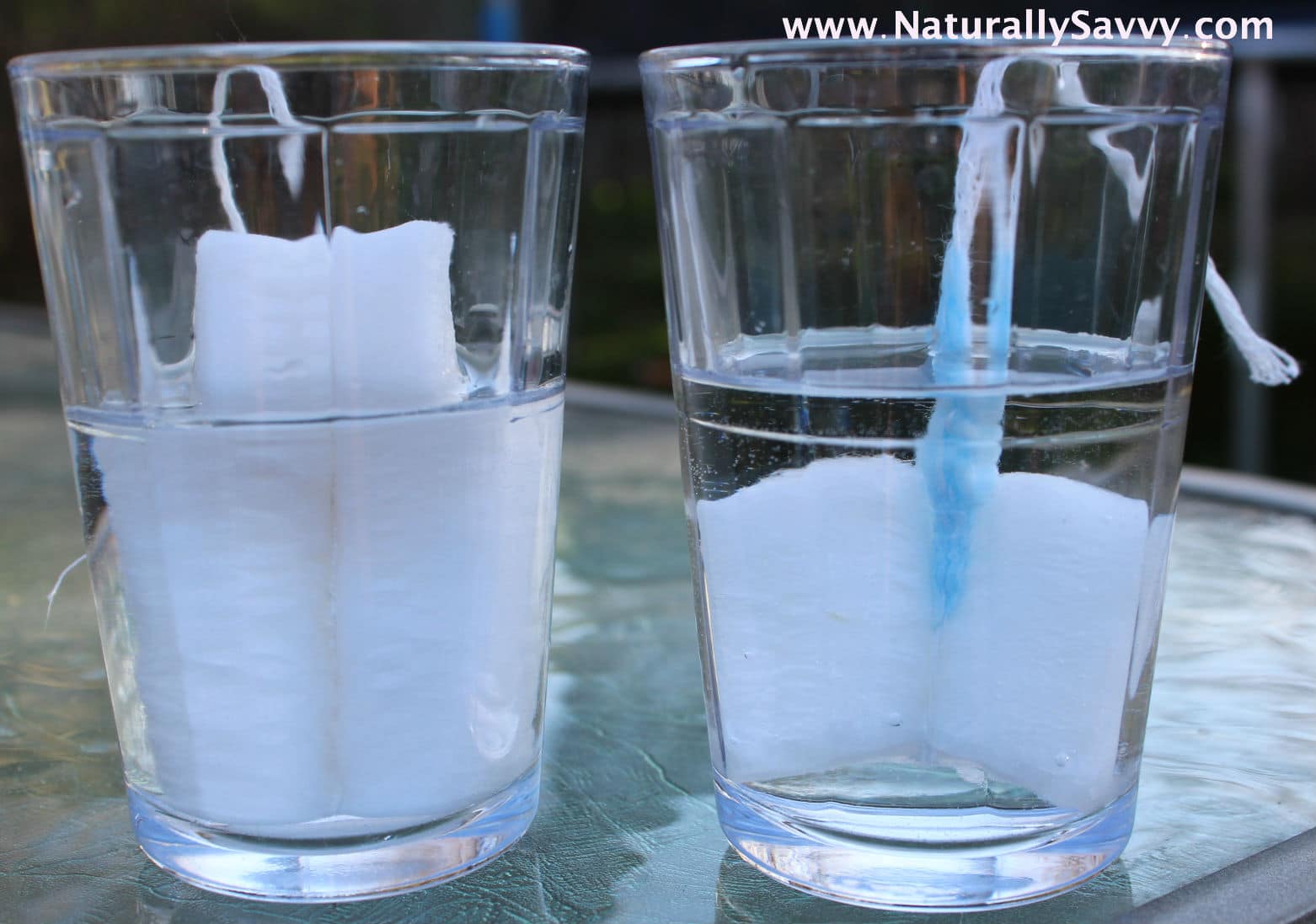
Image above: This is at the onset of my experiment. Natracare organic tampon is pictured on the left and O.B. tampon is pictured on the right. Note the blue dye on the O.B. string. Part of that string is inserted into the vagina with each use. While none of the blue dye leaked into the water (as far as I could see), that doesn’t mean we aren’t absorbing chemicals from the dye into our bodies.
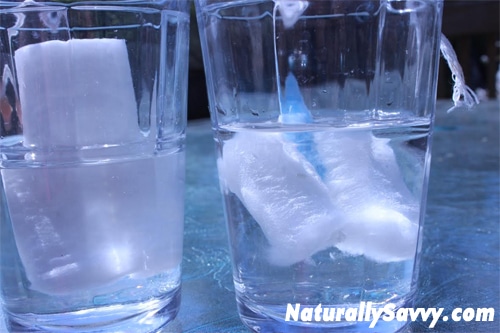
Image above: In this image, the O.B. tampon is on the right, and the Natracare tampon is on the left. I took this image about 2 hours into the experiment. Notice the fibers shedding at the bottom of the O.B. tampon.
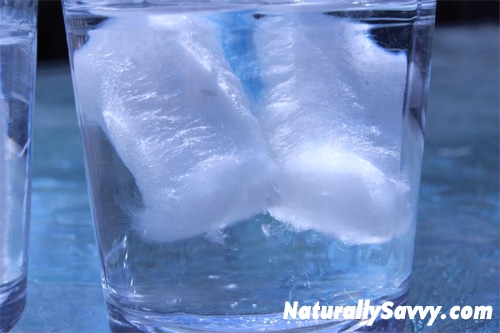
Image above: Here is a close-up of the O.B. tampon starting to shed its fibers about 2 hours into the experiment.

Image above: I took this picture the next morning after leaving both the O.B. and Natracare tampons in water overnight. Notice the marks on the left and right side, and the rayon fibers shedding from the bottom of the tampon and at the bottom of the glass.
Conclusion: Would the rayon fibers release into our system? I don’t know for sure, but I do know that because I have the choice, I prefer to use a tampon that holds its form. Considering we use tampons and/or pads for approximately 2,100 days of our lives, I highly recommend using a 100 percent organic cotton brand. Especially since we put these into and onto our bodies every month, so why take the chance? Even though companies and the FDA assert they are safe, I still believe there is no reason to take a chance, especially when the ingredients don’t have to be disclosed.
For more information on tampons and pads, check out our FREE e-book, Label Lessons: Your Guide to a Healthy Shopper Cart.
The post A Tampon Experiment: A Picture Tells the Tale appeared first on lifesfouhealth.com.
]]>